
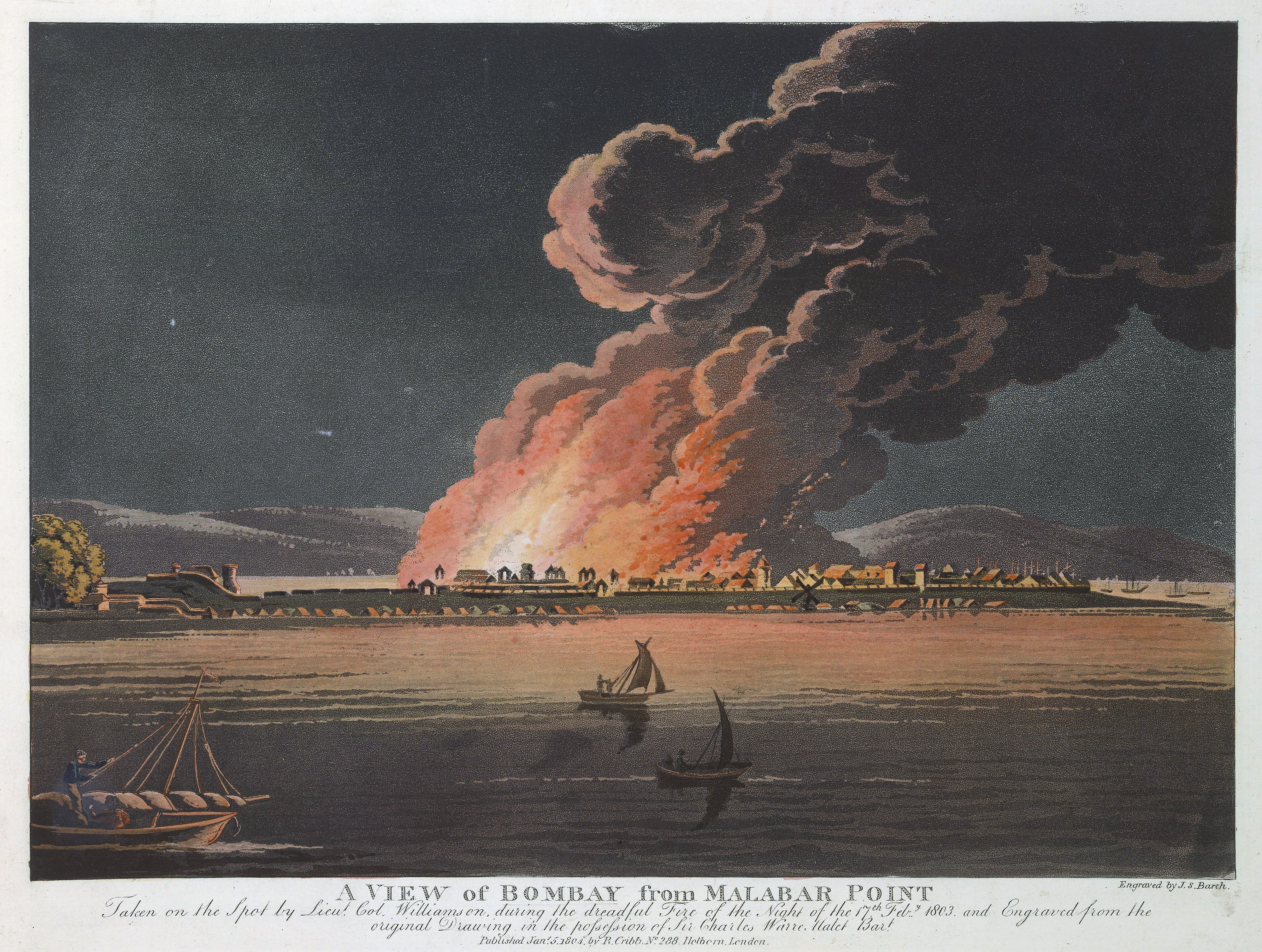
The seven islands of Bombay were joined through large-scale reclamation projects throughout the century. In 1803, a fire destroyed most of the Fort area. This gave the British an opportunity to redesign the settlement. They created wider roads and improved sanitation, while introducing formal systems of urban administration and policing.
The Maratha Empire fell to the East India Company. As a result, Bombay became an even more important British outpost. Improved communication networks were established. The city’s fortunes rose dramatically during the American Civil War (1861–1865), as the blockade of Southern cotton ports shifted demand to Indian markets. Bombay emerged as the leading centre for cotton trading and attracted people from across the subcontinent.
The First War of Independence in 1857 led to the transfer of power from the Company to the British Crown. The transfer marked a new beginning.
These changes created pressure to dismantle the old walls of the Fort and expand the city. The ramparts fell, and the defensive walls gave way to wide avenues, public squares, and administrative buildings. The walls came down to unify the European Fort and the native town. The military Esplanade transformed into a civic and commercial centre. Where cannons once stood, the city built roads and fountains.
A distinct architectural movement developed. Buildings in Victorian, Neo-Gothic, and Indo-Saracenic styles began to dominate the skyline. The Municipal Corporation Building, Bombay High Court, Elphinstone College, and Victoria Terminus exemplified this transformation.
The Bombay Municipality was formed in 1865 and later became the Brihanmumbai Municipal Corporation. The Municipality maintained roads, sanitation, and public health, while governing Bombay as a civic body.
Rich merchant families built hospitals, schools, dharamshalas, water tanks, and gardens. This sense of duty went beyond religion and communalism. The construction of public monuments and fountains reflected pride in a shared urban heritage. The city’s temples, churches, synagogues, and schools no longer stood apart.
Discover more from A Little Bit of Existence
Subscribe to get the latest posts sent to your email.
 A Little Bit of Existence